Skip to main content
Redefining data management for organisations with Microsoft Fabric
August 1, 2024Fabric's SaaS architecture simplifies infrastructure complexities. Activated via the Power BI Admin Portal, the platform ensures swift deployment, scalability, and automatic updates — allowing organisations to focus on actionable insights rather than operational details.
Structuring for success with domain orientation
A Fabric domain is a logical grouping of workspaces. They present a convenient way to manage access and permissions to groups of resources — for example, a domain for Sales and another for Marketing.
Subdomains further isolate management concerns, allowing tailored oversight for specific functions. The domain ownership principle mandates domain teams to take responsibility for their data, moving analytical and operational data ownership away from the central data team.
Collaborative workspaces
The collaborative workspaces within Microsoft Fabric provide a unified environment for data ingestion, machine learning, real-time analytics, and reporting. Managed by regions and capacities, they offer precise control over resource allocation and compliance with regional data regulations.
The role-based access control system — encompassing admin, member, contributor, and viewer roles — ensures data access is secure and appropriately managed.
OneLake: unified storage at the core
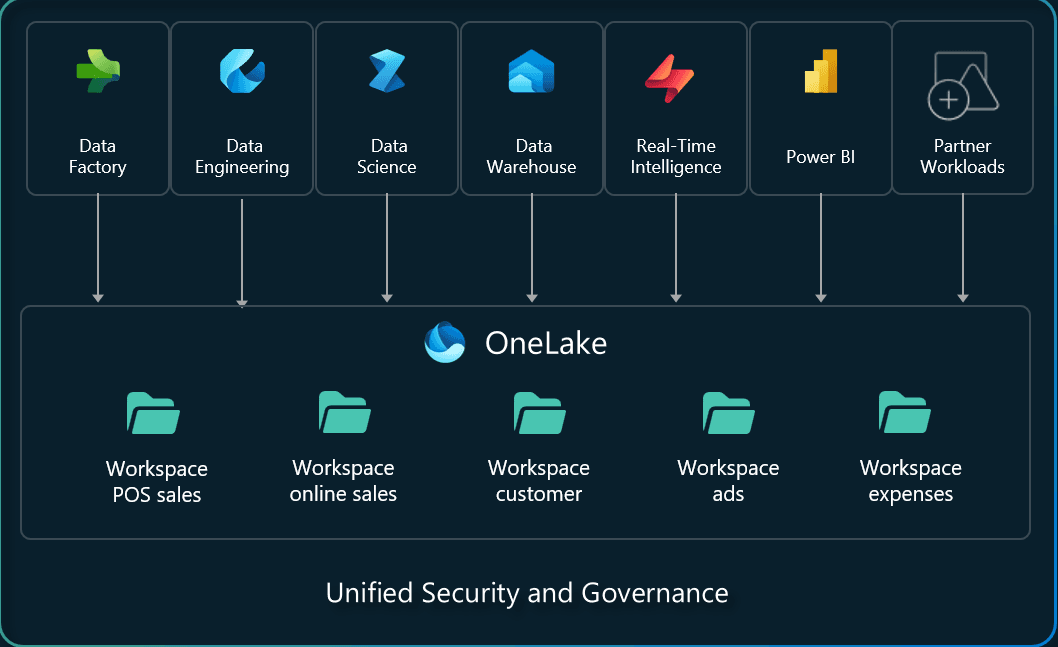
OneLake, the backbone of Microsoft Fabric, unifies data management with a centralised, scalable framework built on Azure Data Lake Storage Gen2. By integrating workspaces, lakehouses, and warehouses, it eliminates silos and simplifies governance, security, and compliance.
With lightweight data virtualisation, OneLake enables real-time access without duplication, enhancing operational efficiency across teams and domains.
Security model
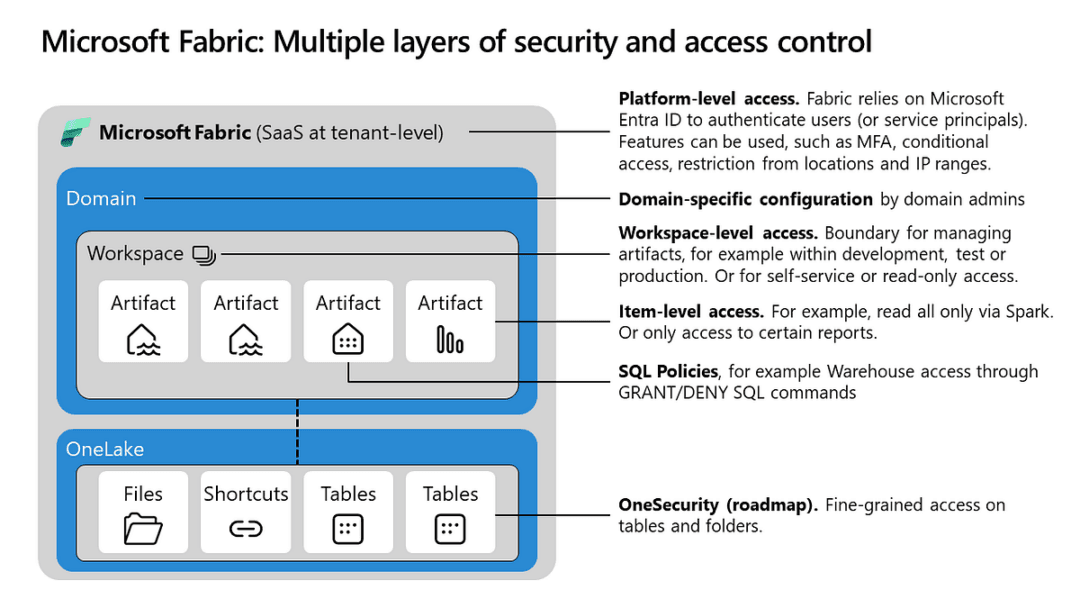
The security model in Microsoft Fabric is multi-layered: platform-level authentication via Microsoft Entra ID with MFA and conditional access, domain-specific configurations for tailored security settings, workspace-level controls for resource management, and item-level access for granular data protection.
More on data platforms and governance
Advancing Your Data Governance Strategy with Microsoft Fabric
Data governance is no longer just about securing information or meeting compliance standards. With Microsoft Fabric, organisations can bring together fragmented tools into one cohesive governance framework.

Cognitive Search: unlocking value from unstructured data
How Tafuta, Arinti's cognitive search platform, helps organisations retrieve value from unstructured data using NLP, speech-to-text, and image processing.

Getting value from large datasets in a short amount of time
We performed a one-week data analysis for NMBS (Belgian railways) on datasets with millions of rows. Here are our tips for investigating large datasets when time is of the essence.

Related Cases
Governed Databricks data platform for global operations
Volvo Logistics distributes over 700,000 spare parts worldwide. We built a governed Databricks data platform that unified operational data from six global sites, delivering up to 40% efficiency gains, 99% reduction in pipeline latency, and self-service analytics for business users.

A hybrid governance model for data and AI at scale
Mercedes-Benz operates a Customer Assistance Center serving 40+ markets worldwide. We defined a pragmatic data & AI strategy, aligning governance, ownership, and technical architecture for scaling on Databricks and Azure within a SAFe environment.