Skip to main content
Smart Monitoring: Predictive Maintenance and Anomaly Detection Explained
January 15, 2021Predictive maintenance reduces downtime, operational costs, and unscheduled maintenance while improving service quality. For Fednot (Royal Federation of Belgian Notaries), we built a smart monitoring dashboard with Azure and Power BI — not just as a proof of concept, but also to introduce their infrastructure team to different levels of Azure AI services.
Converting unstructured data to structured data
Log files are text-heavy and unstructured. The first step was extracting features — structured attributes close to the true factors for prediction. This requires deep understanding of both the data and the business problem. We created a transitional dashboard for feature exploration, letting Fednot select different feature combinations and trace back to original log entries — no coding required.
Azure AI Services across skill levels
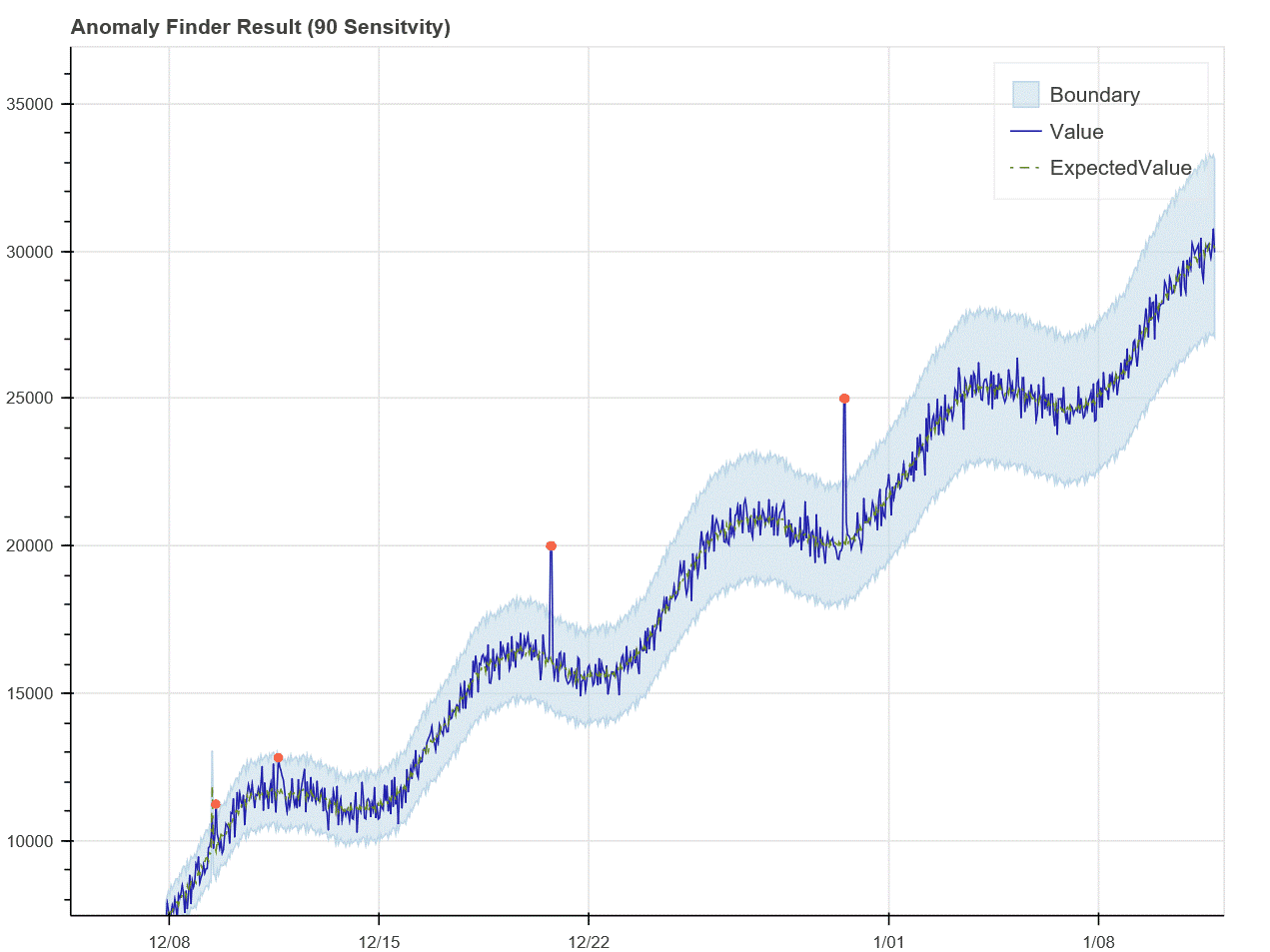
The data pipeline ran on Azure Databricks (code-heavy, for data experts). Anomaly detection used the Anomaly Detector API from Cognitive Services (low-code, a few lines of code). Visualisation used Power BI dashboards (no-code, for decision-makers). The Anomaly Detector takes any time-series dataset, automatically fits a model, and returns expected values, boundaries, and abnormalities — useful for both monitoring and predictive scaling.
Results
Even with limited effort, Fednot gained significant additional value from their monitoring data. The project is a first step towards a data-driven infrastructure environment: reducing unexpected downtime, enabling incident pattern discovery, and improving application quality and customer experience.
— Fisher Kuan & Wouter Baetens
Explore more
Azure Machine Learning – The Responsible Road
Exploring responsible machine learning through Microsoft's framework: understanding, protecting, and controlling AI systems.

AI and RPA for an automated sales order process
How AI and robotic process automation can automate repetitive tasks like sales order entry, demonstrated through an AI assistant called Raphael.

Network flow: a powerful tool for modelling problems
An introduction to network flow algorithms: from finding edge-disjoint paths to solving employee-project matching problems with bipartite graphs and max-flow-min-cost optimisation.