Skip to main content
VDAB Future of Work Challenge
In April 2019, VDAB launched the Future of Work Challenge — an open call for companies and startups to propose data-driven solutions for the Flemish labour market. 33 organisations submitted ideas. Arinti was one of four winners, selected for the CompeTrend proposal: a system that analyses which competencies are growing, shrinking, or disappearing, and maps the similarity between them so jobseekers can find realistic retraining paths.
A labour market under pressure
The Flemish labour market had a low unemployment rate (6% in March 2019) and a rising activity rate (72% in December 2018), but filling vacancies was becoming harder. The skills jobseekers had often did not match what employers were looking for, and new technologies — automation and AI — were expected to widen that gap further.
VDAB had defined four strategies to address this: skills upgrading, retraining, activation, and productivity increase. The Future of Work Challenge was designed to bring in outside perspectives — 33 organisations submitted proposals, and VDAB selected four winners.

“It is important for us to work with an open mind. The Flemish labor market will face new challenges in the next 10 years. We suspected that with all the data we have available, innovative solutions are possible that we hadn't thought of ourselves.”
What we built: CompeTrend
CompeTrend worked with Competent 2.0, the standard competency framework used by VDAB. The system had two components: trend analysis and skill similarity.
Trend analysis
We analysed the evolution of competencies in both vacancies and CVs. The approach involved clearing seasonal cycles and random deviations from the data, then predicting short- and long-term evolution using time series methods (VARIMA and recurrent neural networks). Competencies were classified into categories — disappearing, declining, stable, growing — to surface the trends that mattered for retraining policy.
We also mapped the mismatch between supply and demand: the ratio of vacancies requesting a given competency to CVs listing it.
Skill similarity
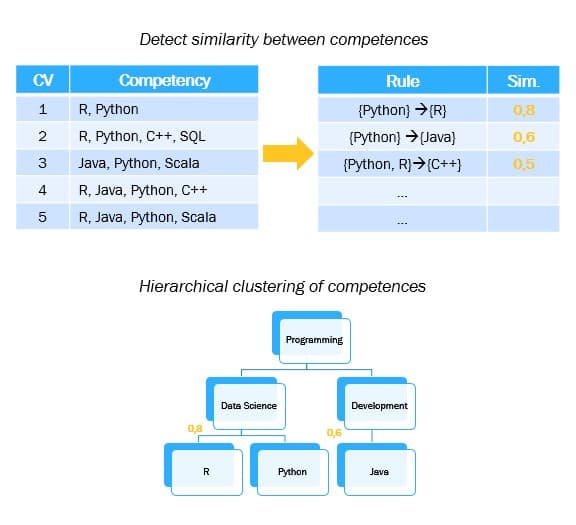
The second component mapped data-driven similarities between competencies using association rule mining on CV data. If two competencies frequently appeared together in CVs, the system scored them as similar. For example: Python and R appeared together with 70% probability, yielding a skill similarity score of 0.8.
These similarity scores fed into hierarchical clustering, grouping competencies that the existing Competent 2.0 taxonomy had not yet connected — giving VDAB a data-driven basis for improving the taxonomy itself.
What CompeTrend delivered
The project supported two of VDAB's four core strategies: skills upgrading and retraining. Concretely, the system provided trend predictions per competency, allowing VDAB to identify which skills were declining before they disappeared entirely. Similarity mappings between competencies showed jobseekers which skills they already had that could serve as stepping stones to future-oriented competencies.
The clustering output also gave VDAB a data-driven basis for improving the Competent 2.0 taxonomy, and enabled faster orientation of jobseekers toward feasible and relevant training paths.