 Skip to main content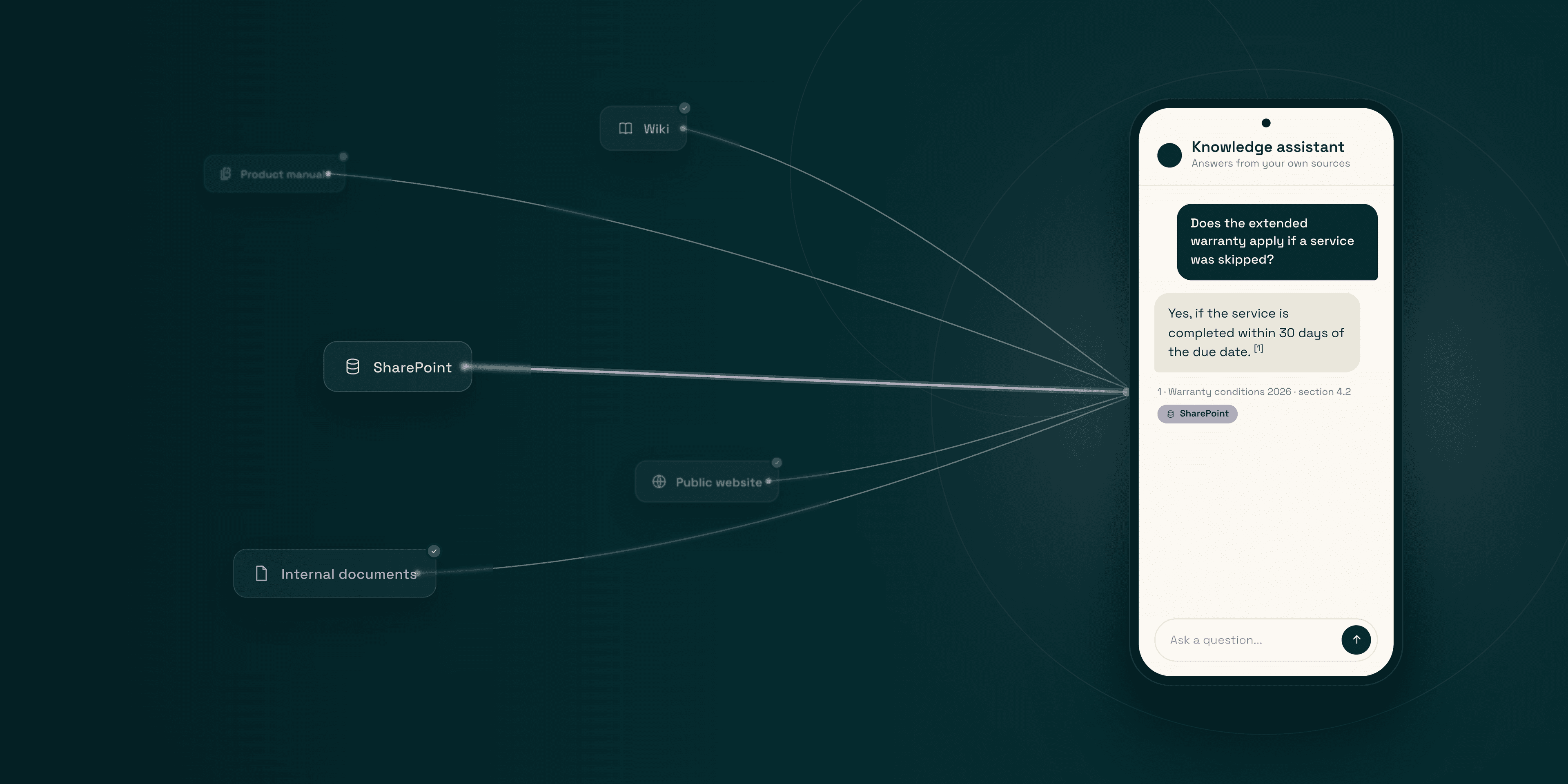
What it takes to scale an internal knowledge chatbot, best practices shared
August 12, 2026One place to ask, answers from your own sources
Most internal knowledge chatbots start for the same reason: the answers exist, but nobody can find them fast enough. Drawing on our recent projects, we look at why organisations start, what makes a pilot scalable, why scaling is more an organisational question than a technical one, what tracing every conversation buys you, and the problems you will run into on the way. Including the newest one: AI-assisted development delivers in weeks, and most organisations aren't set up to give feedback at that pace.
The business case: the knowledge to answer customers exists, but it is scattered across SharePoint sites, wikis, internal documents and public web pages.
At one of our clients, a publisher with a strongly seasonal business, the problem was simple. During the annual peak, four departments answer the same kinds of questions from the same scattered sources. Every minute an employee spends searching is a minute a customer waits, and two colleagues digging through different documents can give two different answers.
An internal knowledge chatbot attacks exactly that: one place to ask, answers generated from the organisation's own sources, the same answer for every colleague.
The business case usually rests on three legs.
- Speed: an answer in seconds instead of a search through folders.
- Consistency: every team answers from the same knowledge base.
- Resilience: knowledge that lives in a searchable index instead of in the heads of a few experienced colleagues survives holidays, peak loads and staff turnover.
There is a fourth, quieter reason many organisations start here: a knowledge bot is a contained, measurable first step in a broader AI ambition. It touches real work, its quality can be tested question by question, and the index it builds becomes reusable infrastructure for whatever comes next.
Key takeaways
- Start narrow, on foundations that don't. One use case, a handful of sources, but a central index, agent-ready orchestration and your existing identity platform underneath. Skip that and scaling means rebuilding.
- Scaling is an organisational question. A pilot is configured by developers, a platform by the business. The turning point is an admin portal where teams create their own variants with their own sources.
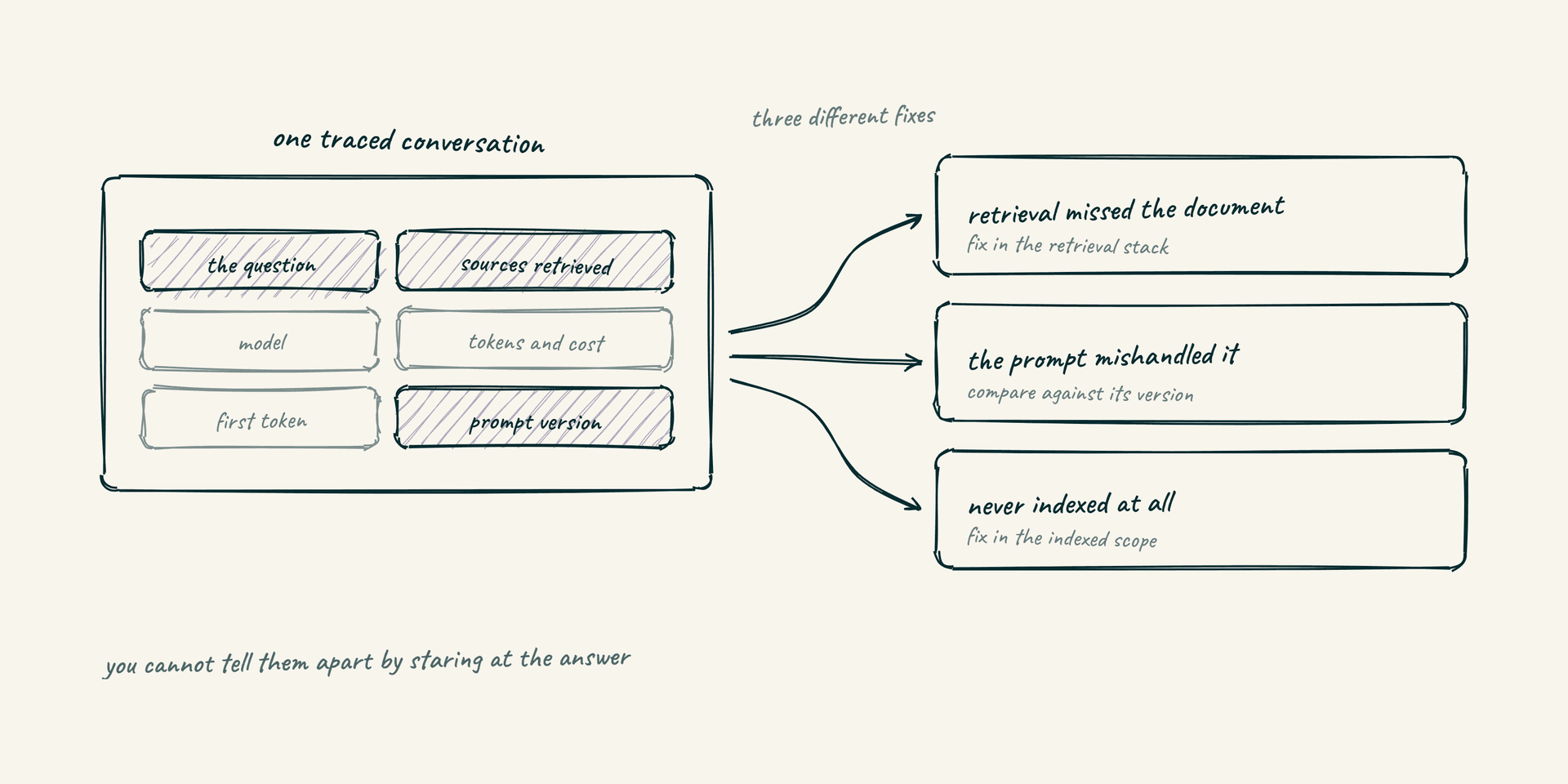
- Without traces, a wrong answer is not actionable. One trace separates retrieval that missed, a prompt that mishandled, and a source that was never indexed. The answer itself tells you none of that.
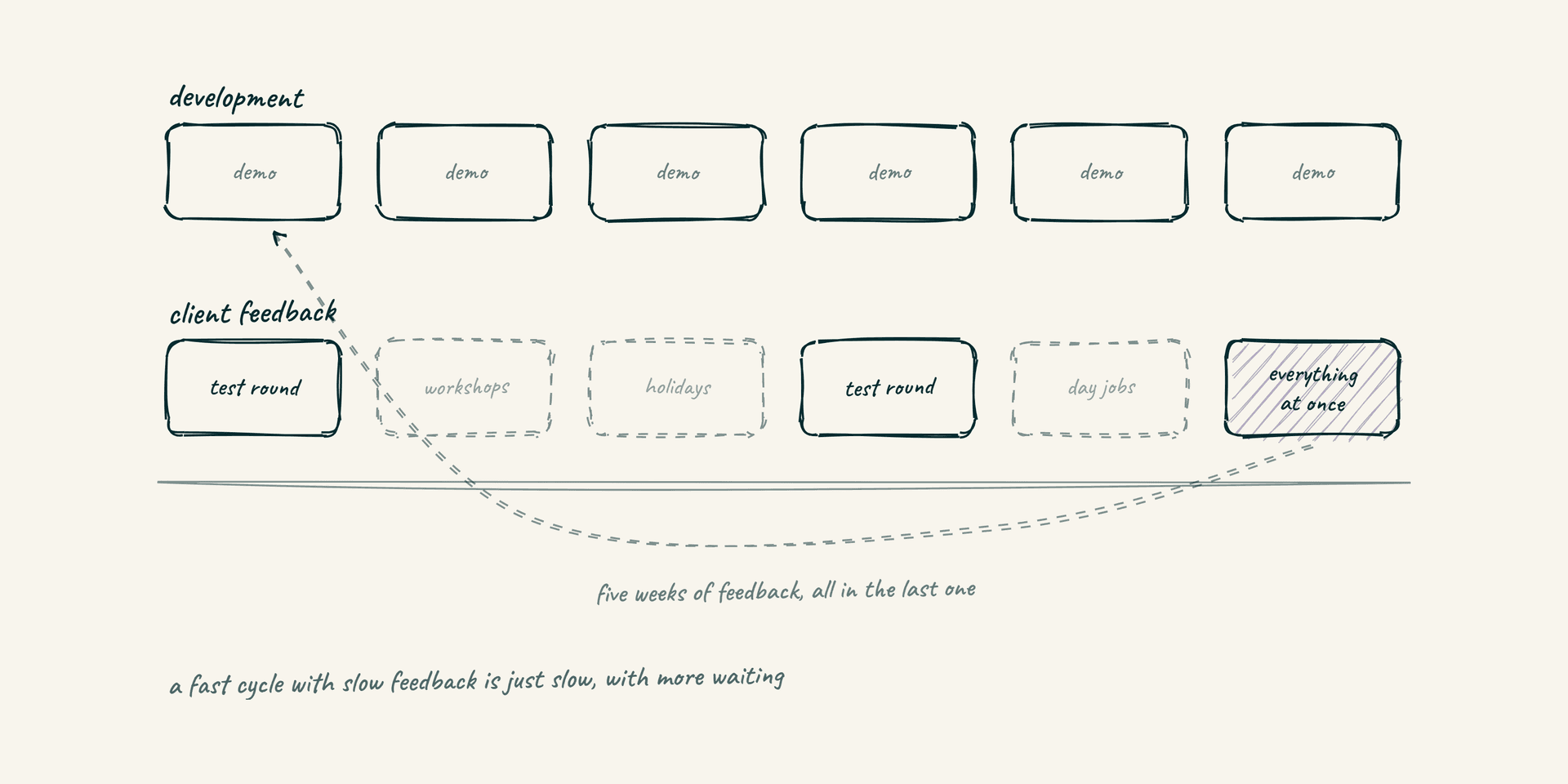
- The bottleneck moved to the client side. Weekly demos assume someone tests weekly. Client feedback capacity is now a planning item, as real as development capacity.
- Measure quality, don't demo it. 40 to 50 real questions from the floor, 9 out of 10 answers rated good or neutral by the client's own testers. That carries a budget conversation.
Start small, but on foundations that scale
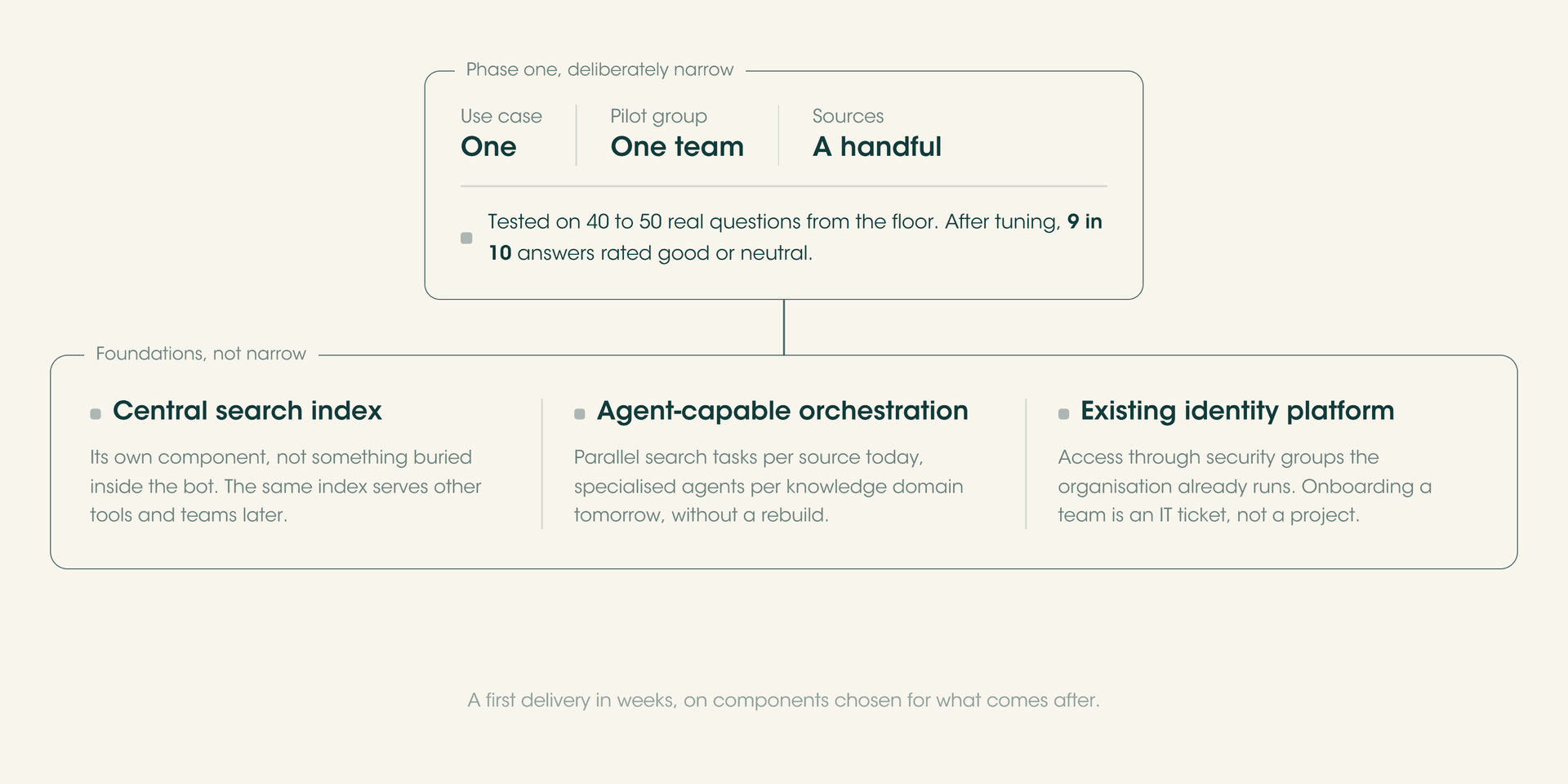
The pilots that grow into platforms share a pattern: a deliberately narrow first phase built on components chosen for what comes after.
Narrow means one clear use case, a pilot group, and a handful of sources.
That keeps the first delivery to a matter of weeks and, more importantly, makes quality measurable. Our seasonal client tested the pilot against 40 to 50 real questions from the floor; after a round of tuning, 9 out of 10 answers were rated good or neutral by their own testers. Numbers like that carry a budget conversation better than any demo.
Narrow also applies to the data. Don't wait for a company-wide clean-up before you start, but do push for a minimal one on the subset you index: a well-organised folder structure or consistent tagging is what later lets you point a team's assistant at exactly the right sources. A small, reasonably clean subset is enough to start, and it has a useful side effect we see on every project: once colleagues see the assistant answering from their documents, they suddenly find the motivation to tidy up the rest.
The foundations, though, should not be narrow. Three choices in the first phase decide whether the pilot can grow.
A central index as its own component
A central search index as its own component rather than something buried inside the bot: the same index can later serve other tools and teams.
A framework that supports agents
A question can fan out into parallel search tasks per source today and grow into specialised agents per knowledge domain tomorrow, without a rebuild.
Sign-in through the platform you already run
Access managed through existing security groups means onboarding a new team is an IT ticket, not a development project.

A pilot is configured by developers. A platform is configured by the business.
Scaling is an organisational question
What actually decides whether a knowledge bot spreads through an organisation is who can change it, and how fast.
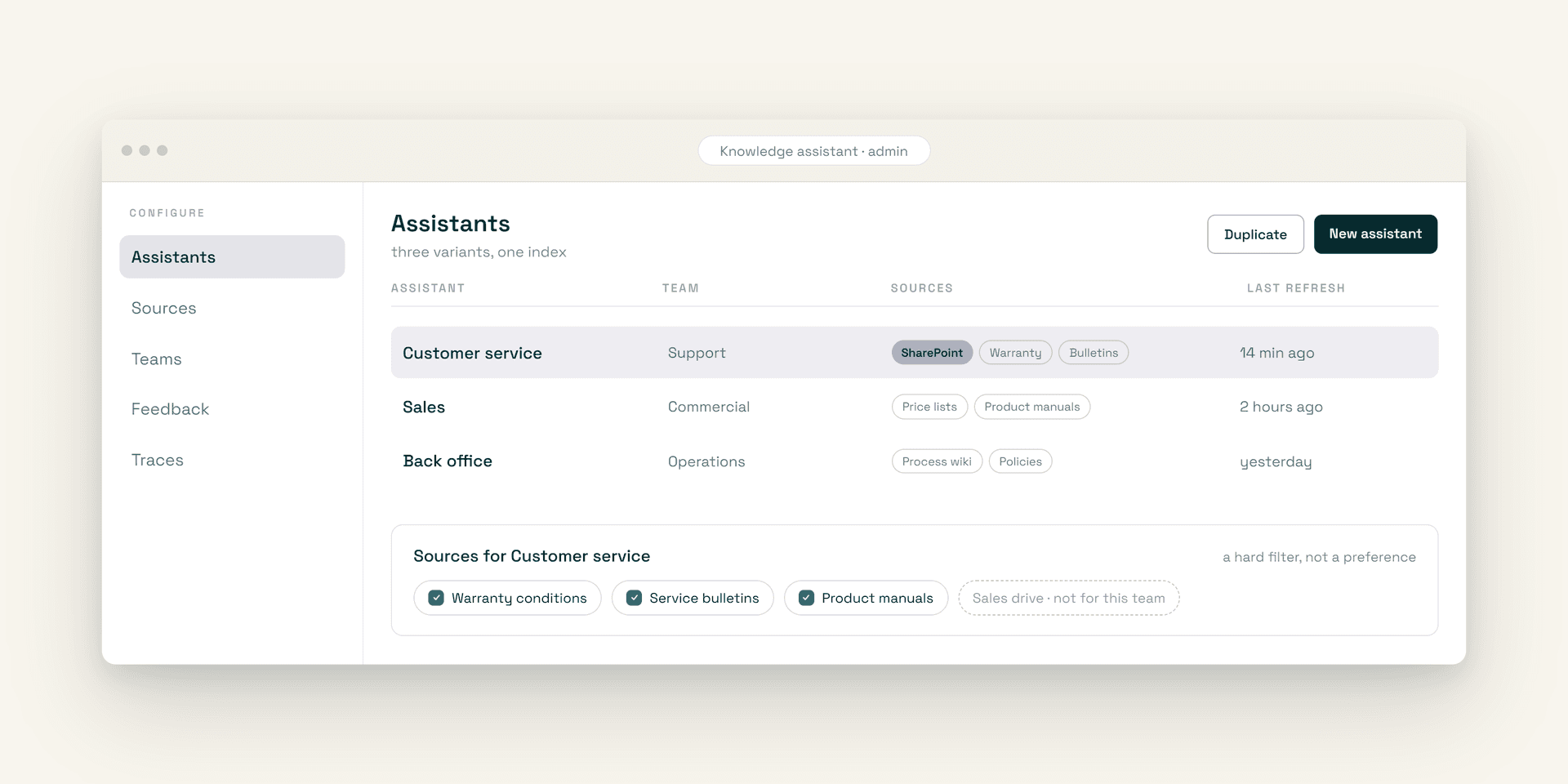
A pilot is configured by the development team. A platform is configured by the business. The turning point is an admin portal where the organisation's own people create variants of the assistant per team: each with its own instructions, tone of voice and, crucially, its own sources.
Variants that works for one department can be duplicated and adapted for the next in minutes. Sources per team also work as a hard filter, which is not a nice-to-have: a customer-facing team should not be able to accidentally quote from documents that were never meant for them.
Two more things keep a scaled bot healthy.
- Automated content refresh: changes to sources should reach the assistant in minutes to hours, without anyone remembering to press a button.
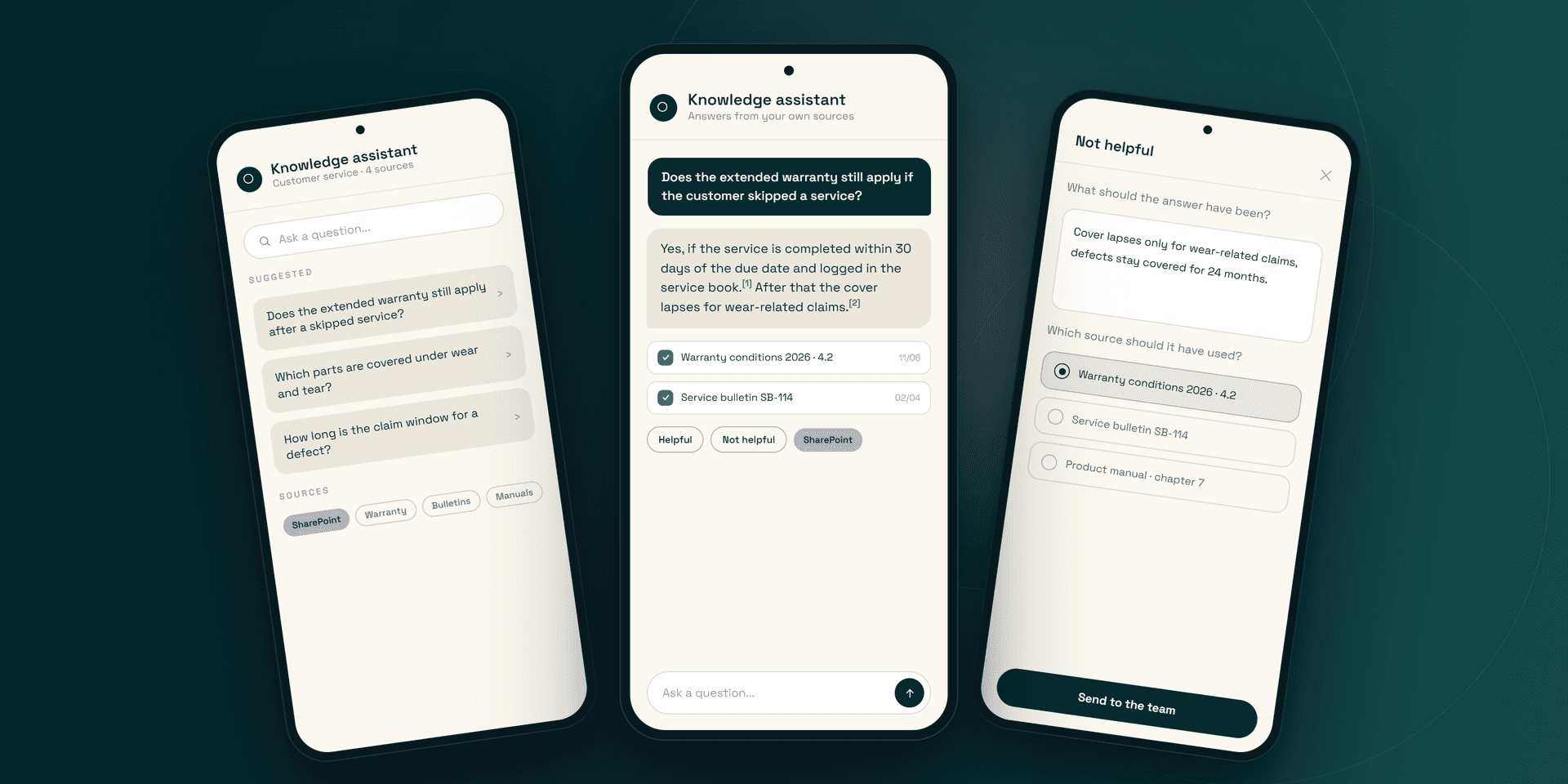
- And a real feedback loop: structured rounds where users report not just "this answer was wrong" but what the expected answer was and which source it should have come from.
Set that testing up on day one, with tooling the business side can actually work with, or you will be fielding "why does it answer like this" questions the day before go-live.
Insights turns opinions into evidence
"The bot gave a wrong answer" is not something you can act on.
Tracing is what turns it into a ticket. On the assistants we run at scale, every conversation is traced in Langfuse: the question, the sources that were retrieved, the model, tokens in and out, the estimated cost, the time to first token, and the version of the prompt that produced the answer. When a user reports a bad answer, that trace tells you which of three different problems you have. Retrieval missed the right document, the right document was retrieved but the prompt mishandled it, or the source was never indexed in the first place. Three problems, three different fixes.
Building that layer taught us two things worth passing on.
Keep functional and operational insights seperate
The instinct is to send everything to one place, and it backfires: technical diagnostics, HTTP requests and database calls flood the view until the conversations you actually want to read are unfindable.
We now give each system a documented, non-overlapping scope, with LLM behaviour in Langfuse and application and infrastructure monitoring in the standard APM stack. That split is more work than it sounds, because a trace is a tree: pull the technical spans out naively and the remaining spans lose their parent, so the structure collapses into fragments. It takes deliberate instrumentation to keep the functional view readable, and on one project we built our own fix for exactly that, with the intention of open-sourcing it.
Give the client access to the traces
Prompt tuning without traces is guessing, and the people who can judge an answer are the client's domain experts, not the development team. On one project we set up single sign-on through the client's own identity provider so their team could open traces with their existing accounts; on another, tracing every agent conversation meant we refined prompts together with the client instead of debating quality in the abstract.
Two practical caveats:
- Decide with the privacy officer up front what a trace may contain, because conversation logs are personal data territory and a technical identifier without user details is often enough.
- Watch the bill: a self-hosted observability stack is a running cost of its own, in one case several hundred euros a month before we tuned it down to actual usage.
AI-assisted development moves the bottleneck
We build with AI-assisted development ourselves, and the effect on delivery is real: work in short, iterative sprints, a working demo every week, and a phase that used to take months delivered in a handful of weeks, at higher quality, because the time won goes into review and testing rather than typing.
Development can now move faster than most client organisations can absorb. A weekly demo cadence assumes someone on the client side tests weekly, decides weekly, and gives feedback weekly, and most organisations are simply not staffed or organised for that. On one project, the features were demo-ready week after week while the designated testers were absorbed by workshops, holidays and their day jobs. The development team could keep building, but the quality tuning that depends on domain feedback stood still, and everything threatened to land in the final week before delivery.
The conclusion is not to slow down. It is that client-side feedback capacity has become a planning item, as real as development capacity. Agree the cadence at kickoff: who tests, how many hours per week are reserved for it, and in what format feedback arrives?
Structure that format, so a tester reports the concrete problem, the expected answer and the expected source rather than a general impression.
And treat client availability as a project risk: a holiday period in the wrong place costs a full iteration, so plan around the calendar of the people who will test, not just the people who will build.
What we ran into
Every knowledge bot project we have done hit a version of these six problems. Better to plan for them than to discover them.
The knowledge base is messier than anyone admits
Contradictory documents, outdated versions nobody ever archived, and above all missing classification: without structure you cannot point the assistant at the right sources for a use case. Expect a data conversation in every knowledge bot project, and have it early.
The assistant will confidently mix up look-alikes
In one test round, users caught the bot answering a question about one product with information about another product with a nearly identical name, citing the wrong source, an error a new employee would never recognise. Inline, clickable source citations are the safety net; hard source filters per team shrink the room for confusion; and the honest lesson is that only domain experts catch this class of error, which is why structured testing by real users is not optional.
Retrieval quality is a stack, not a setting
Whether the right document surfaces is decided by several techniques working together: keyword search combined with semantic search, boosting by document type or date, reranking (retrieve fifty candidates, re-analyse them against the question, keep the best handful), and rewriting the user's question in context. Each layer measurably moves the results, and the tuning keeps evolving; on the query rewriting alone, we started with keyword-style rewrites and now see natural, full questions retrieve better. Budget for iterating on this stack, not for configuring it once.
A source citation promises more than the assistant saw
Retrieval feeds the model fragments of a document, but the answer links to the whole document, so users assume the assistant read all of it, and the follow-up "what is this document about" gets a strangely thin reply. We now close that gap deliberately: indexed summaries per document on one project, and on another, tools that let the assistant open a specific document by name and read through it when a question calls for it.
Scope questions surface late
The moment a bot answers well, someone asks the uncomfortable question: what exactly can it see? Be able to answer precisely which folders and pages are indexed, keep the indexed scope deliberately demarcated, and expect requests to restrict certain user groups to curated variants only. The same goes for the logging layer described above: settle it with the privacy officer before you build it, because retrofitting approval stalls the roadmap.
The ground moves under you
During one project, the language model we started on was scheduled for retirement before the project ended. Treat the model as a replaceable part: build and test against upgrades as part of the plan, and assume the model you launch on is not the model you will run on in a year.

From one bot to a team of agents
Across our projects the same evolution repeats: a simple RAG assistant first, then a smarter agent with tools it can decide to use, and eventually a fleet of specialised agents that cooperate, with an orchestration layer that judges per source whether it has something relevant to contribute. For the business that means better answers on a wider knowledge base without the accuracy dropping as sources multiply.
Two lessons from walking that path.
- The mundane one: an agent needs to be told who it is, which organisation it works in, and what it may and may not do; on one project the assistant did not even know its own name until we wrote it into the instructions.
- The strategic one: more autonomy is not automatically better. Every degree of freedom you give an agent costs tokens and latency, so we still deliberately keep parts of the flow scripted, with a layered setup where identity, scope and rules live in the system prompt and the approach is chosen based on what the user is actually asking.
But agents remain step two. The organisations that get there are the ones that first made the narrow version work, measured it, and gave their own people the controls. Thinking about an internal knowledge assistant for your own organisation? We are happy to show what one looks like in practice.