Skip to main content

Regelspotter: how AI turns legislation into concrete tasks per building
October 27, 2026
Overview in the rules
If you have a gas boiler at home, it needs maintenance by a certified technician every two years. Hardly anyone thinks about that until something goes wrong. When a fire breaks out, one of the first questions from the insurer is whether you can show the maintenance certificate.
In an office building, far more is at stake. A building holds dozens of installations, each with its own rules, and a single building manager at Het Facilitair Bedrijf, the facility management agency of the Flemish government, can be responsible for up to 60 buildings. What building managers lack is an overview: which rule applies to which building, what needs to happen, and whether it can be proven that it did.
That is the challenge Het Facilitair Bedrijf brought to the Vlaanderen Hackathon 2026, organised by Digitaal Vlaanderen, PIO, VLAIO and Sandbox Vlaanderen. Over three days in October, a joint team from Het Facilitair Bedrijf, Arinti, Cronos Public Services and Leap Forward built Regelspotter. On 22 October, the audience at Trefdag Vlaanderen Digitaal chose it as the winner, ahead of finalists from VLAIO and the Agency for Nature and Forests.
See, do, prove
Regelspotter supports building managers in three steps, the same three that keep a home boiler in order.
See
The building manager sees which obligations apply to each of his buildings, without having to work through legal texts himself.
Do
Every obligation becomes a concrete task in the existing maintenance planning, such as having a boiler serviced every two years, with a reminder when it is due.
Prove
Once the technician has done the work, the certificate is linked to the task and lands in the building file, ready when an inspector or insurer asks for it.

One register between the sources and existing systems
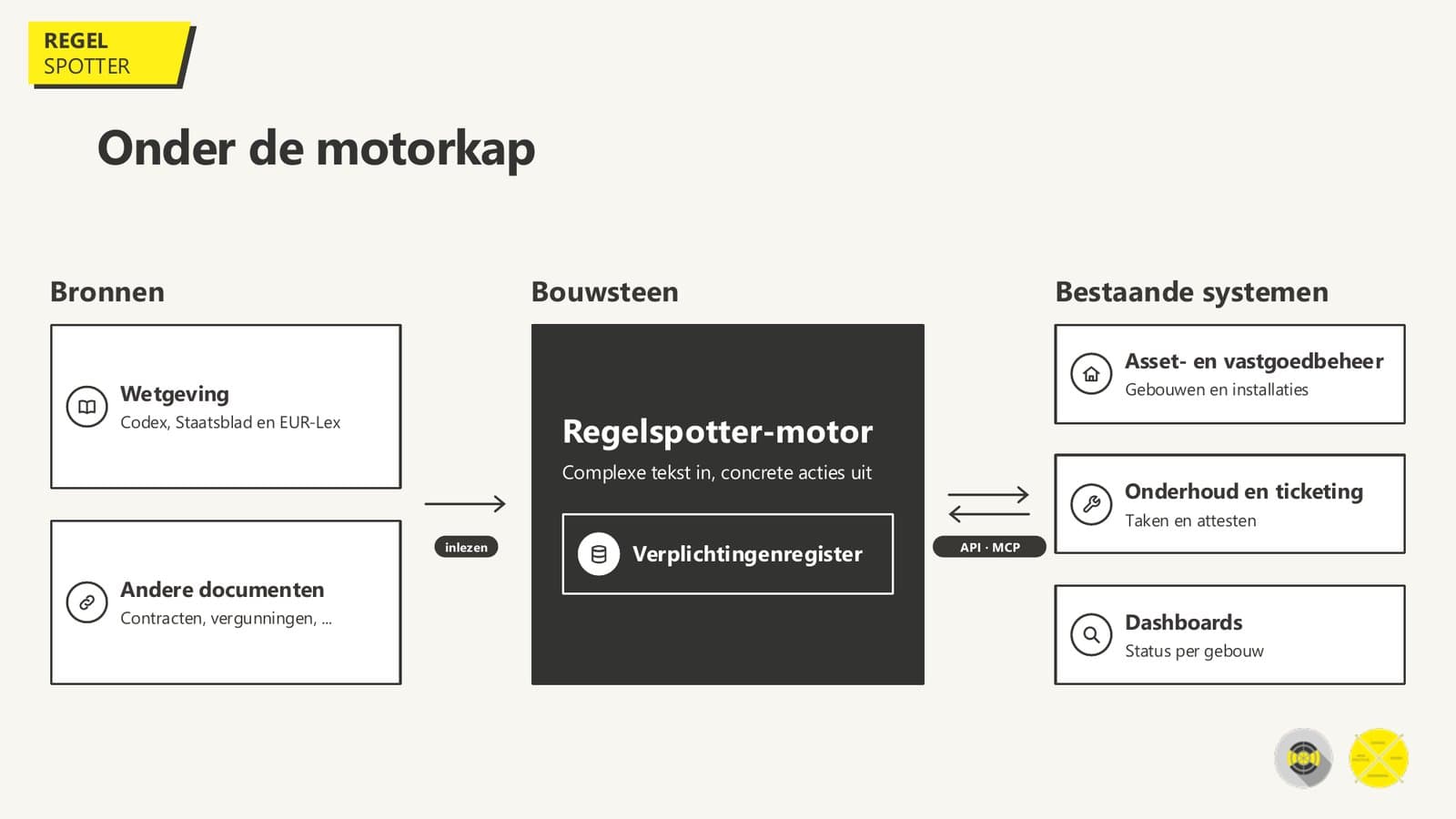
At the centre sits the Regelspotter engine: complex text goes in, concrete actions come out. It reads legislation from the Flemish Codex, the Belgian Official Gazette and EUR-Lex, and can also process other documents such as contracts and permits. The result is an obligations register.
That register connects through a REST API and MCP to the systems building managers already use: asset and real estate management for buildings and installations, maintenance and ticketing for tasks and certificates, and dashboards that show the status per building. Nobody has to learn a new application to follow up their obligations.
The interface is built on the components of the Digitaal Vlaanderen design system. Accessibility is built in following the WCAG guidelines, and the tool looks familiar to anyone who uses other Flemish government applications.
From legal text to obligation in the register
The engine works in three phases, with fixed gates in between where a person decides before the process continues.
1. Prepare
The legal text is extracted from the PDF and split into individual provisions. The system then checks which act it concerns and whether that act is still in force. A triage step afterwards decides per provision whether it can impose anything on a building manager. At the first gate, a legal expert confirms or corrects that selection before the analysis starts.
2. Analyse
An orchestrator distributes the work over specialised agents. They draft candidate obligations and compare them with what is already in the register. A quality check in code follows: quotes must match the legal text literally, coverage must be complete and there can be no duplicates. If the check fails, the analysis goes back once with the issues as feedback. At the second gate, a legal expert approves, revises or rejects each candidate separately. When the expert asks for a revision, only those candidates are reworked, and approved ones stay locked.
3. Register
This phase runs entirely in code. One obligation is drafted per variant and per asset type, then written to the register through the REST API together with the legislation, the source document and the underlying rules. When the system proposes a new asset type, someone from data governance decides first at a third gate. Everything lands in the register as a draft, and publishing remains the expert's call. A checkpoint after every step means the process can restart without duplicate work.
AI proposes. People decide.
Where people sit in the loop
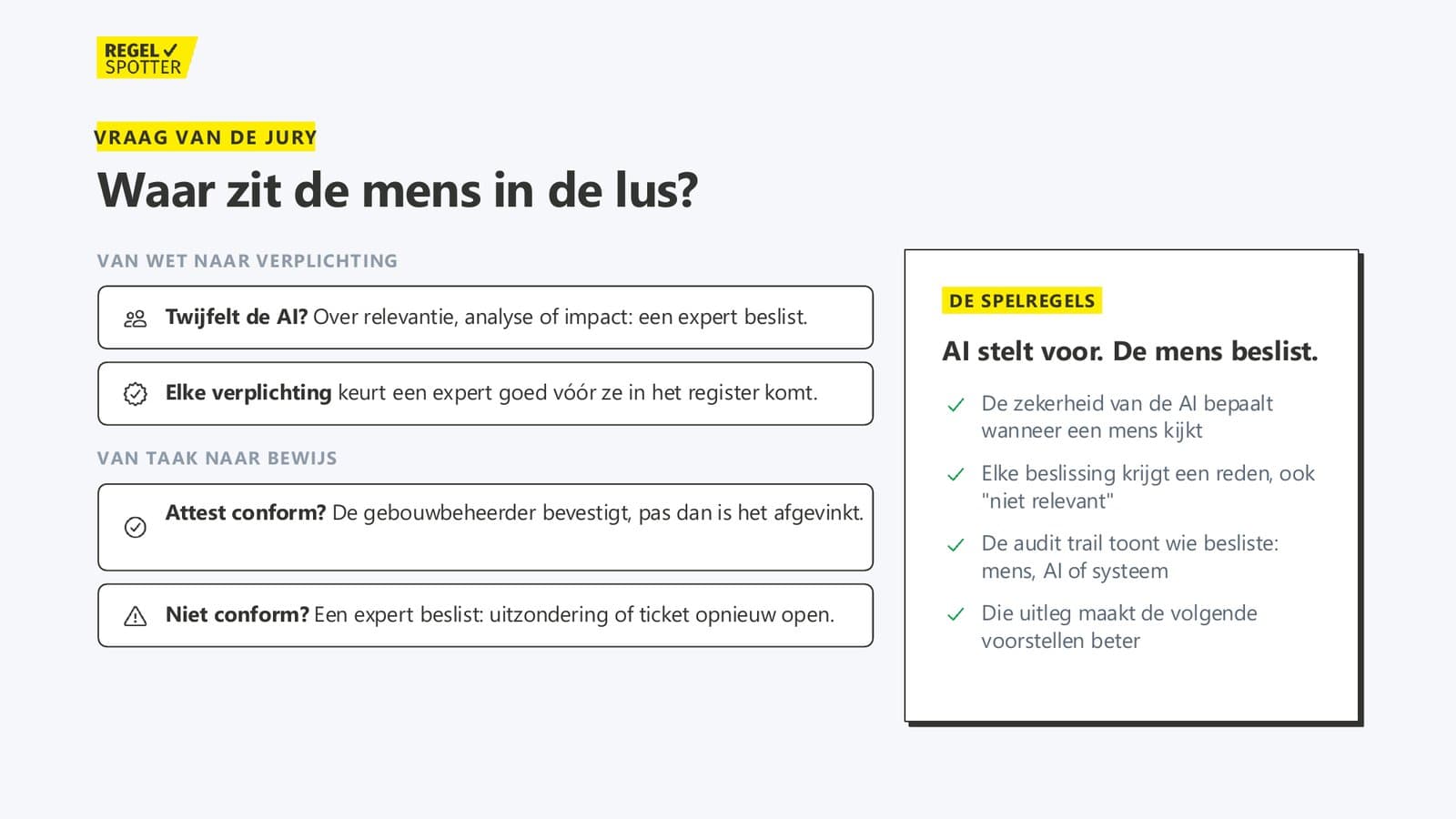
During the final, the jury asked exactly this question. The answer is built into the design. When the AI is in doubt about relevance, analysis or impact, an expert decides. No obligation enters the register without an expert's approval. On the execution side, a task is only ticked off once the building manager confirms that the certificate is compliant. If it is not, an expert decides between an exception and reopening the ticket.
A few ground rules hold this together:
- The AI's confidence determines when a person needs to look.
- Every decision gets a reason, including "not relevant".
- An audit trail shows who decided: a person, the AI or the system.
- Those explanations are used to improve the next proposals.
One model per role, code for the rest
All models run in Azure AI Foundry, and each one has a defined job. Mistral Document AI extracts the text from the PDF. A reasoning model orchestrates the analysis and drafts candidate obligations. A lighter model handles triage and the comparison with the register. A decision model from Microsoft gives the reviewer a calibrated confidence score per candidate without generating any text. Everything predictable, such as splitting text, quality checks, registration, linking, tasks and the audit trail, is plain code.
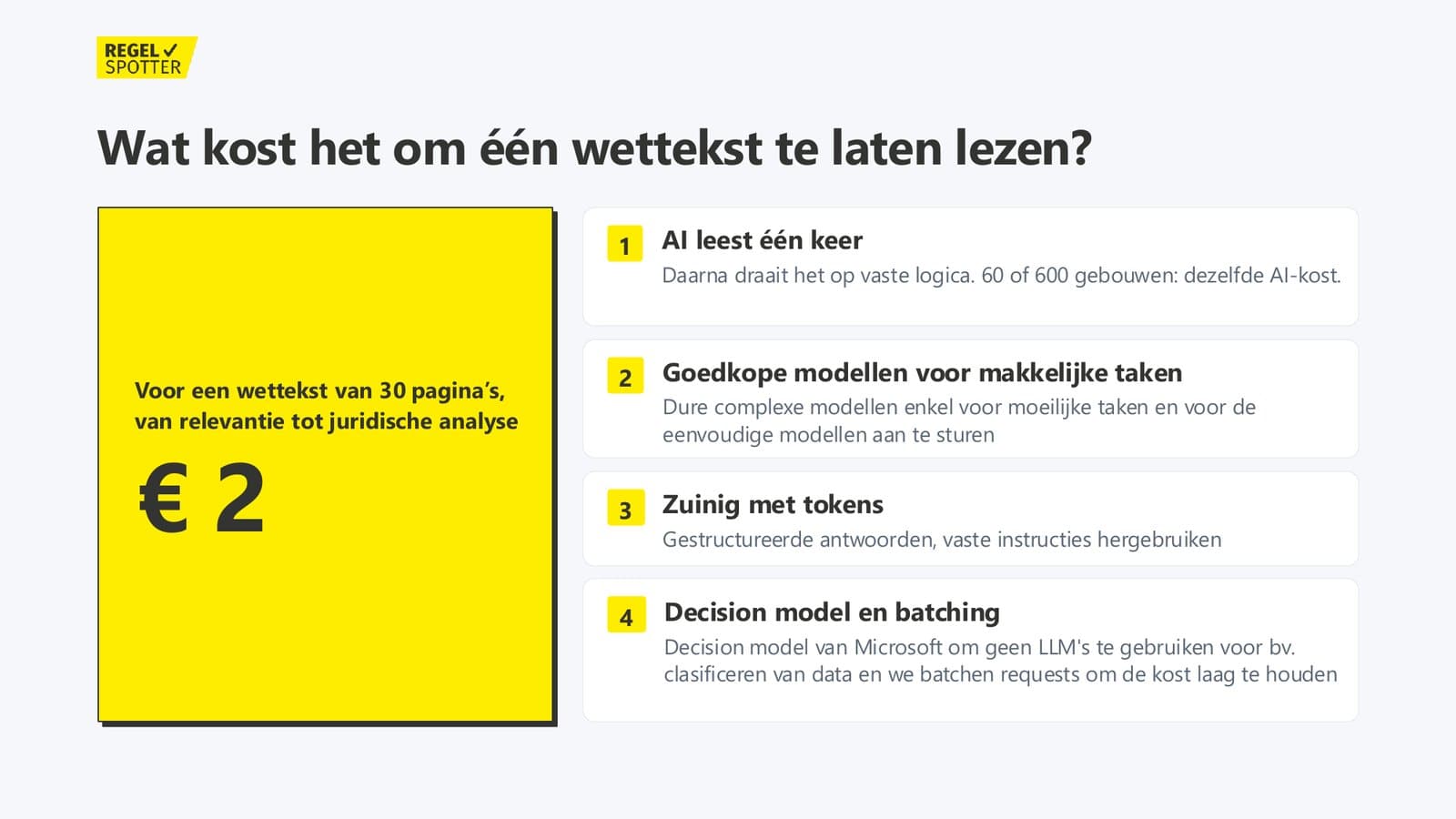
That split keeps the cost low. Analysing a 30-page legal text, from relevance check to legal analysis, costs about two euros in AI. Four choices make that possible:
- AI reads once. After that, everything runs on fixed logic, so applying a rule to 60 or 600 buildings costs the same in AI.
- Cheap models for easy tasks. Expensive models are reserved for hard reasoning and for steering the simpler ones.
- Economical with tokens. Structured outputs and reusable instructions.
- Decision model and batching. Classification runs without an LLM, and requests are bundled together.
Regelspotter in numbers
What it could deliver
The team estimates that Regelspotter can halve the administrative workload of following up regulations, worth around €600,000 in staff costs per year at Het Facilitair Bedrijf. That figure is an estimate based on the current way of working, not yet a measured result.
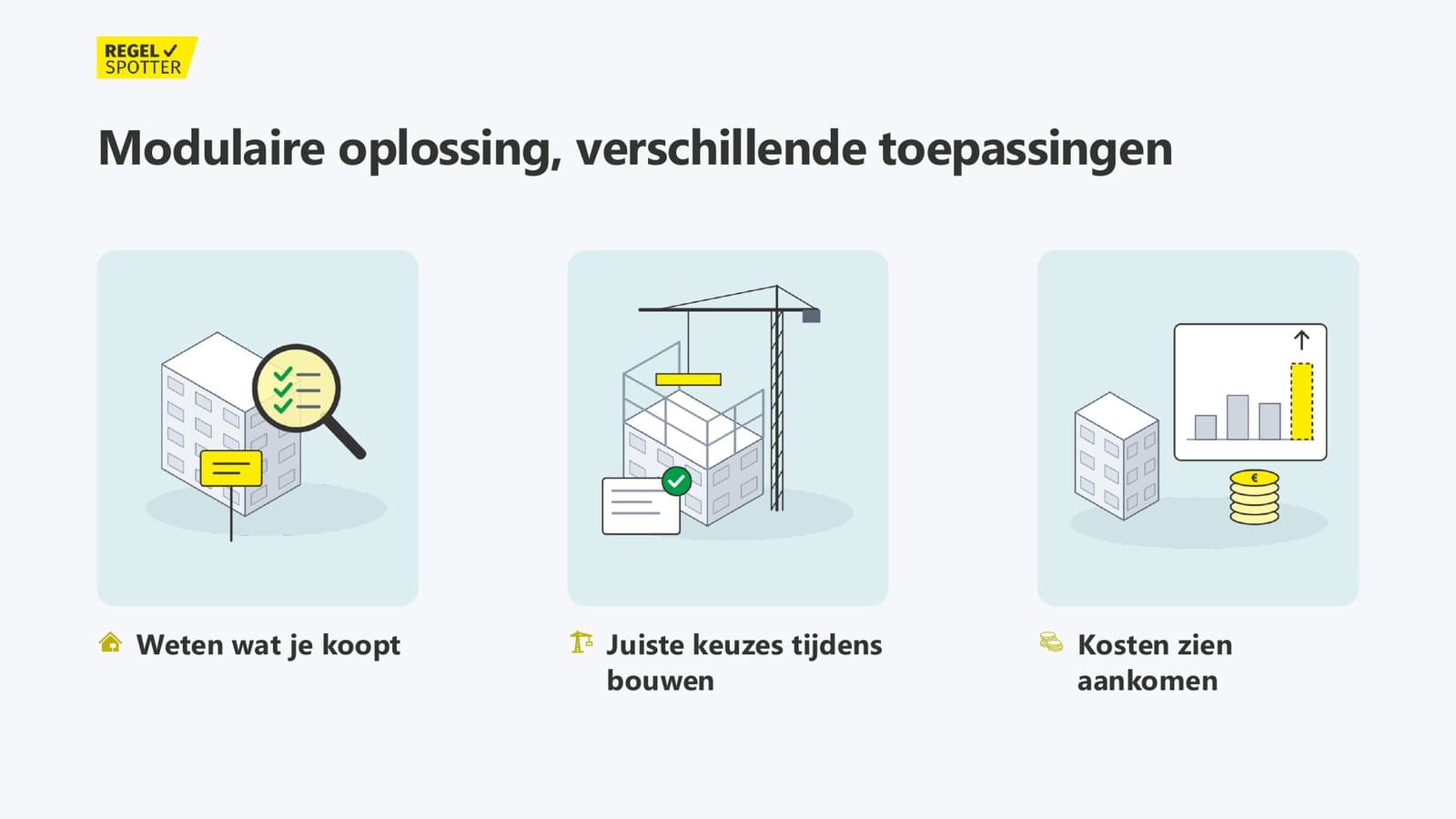
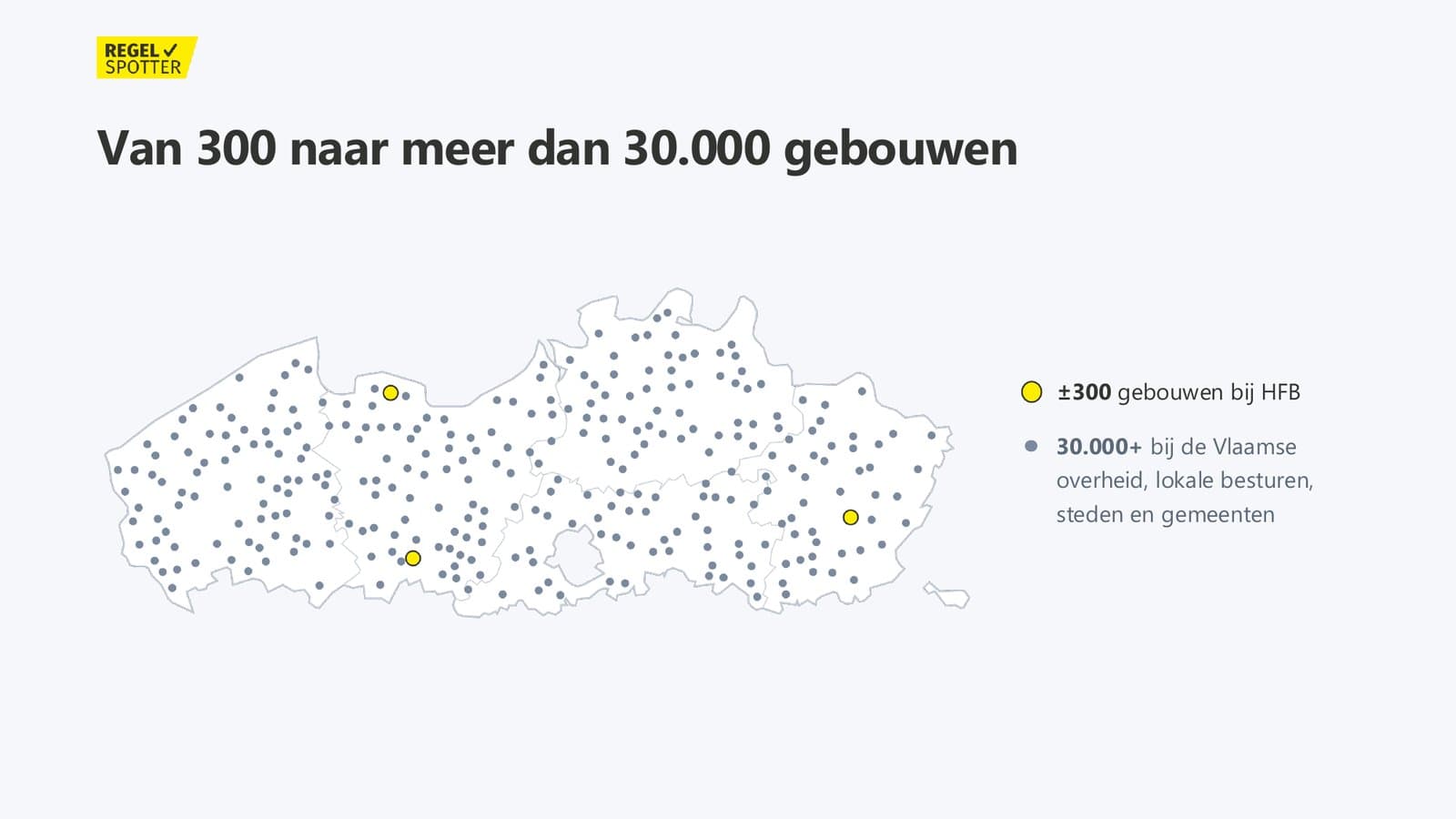
The larger potential lies in scale. Het Facilitair Bedrijf manages around 300 buildings, while the Flemish government, cities, municipalities and other local authorities together manage more than 30,000 buildings that fall under the same legislation. Because the solution is modular, other applications are within reach as well: knowing which obligations you take on when you buy a building, making the right choices during construction, and seeing the cost of mandatory interventions coming.

From prototype to production
After three days of hacking, the register API already runs in Azure. The analysis pipeline runs locally for now, and the steps to move it to Azure are mapped out. A hackathon delivers a working prototype, and the real value comes once building managers use it every day. That is where we want to go together with Het Facilitair Bedrijf.
Congratulations to the whole team, and thanks to Digitaal Vlaanderen, PIO, VLAIO and Sandbox Vlaanderen for the organisation. Does your organisation also need to turn legislation, contracts or other complex documents into concrete actions? Let us know!