Skip to main content
How UCLL is making Copilot answer from its own sources
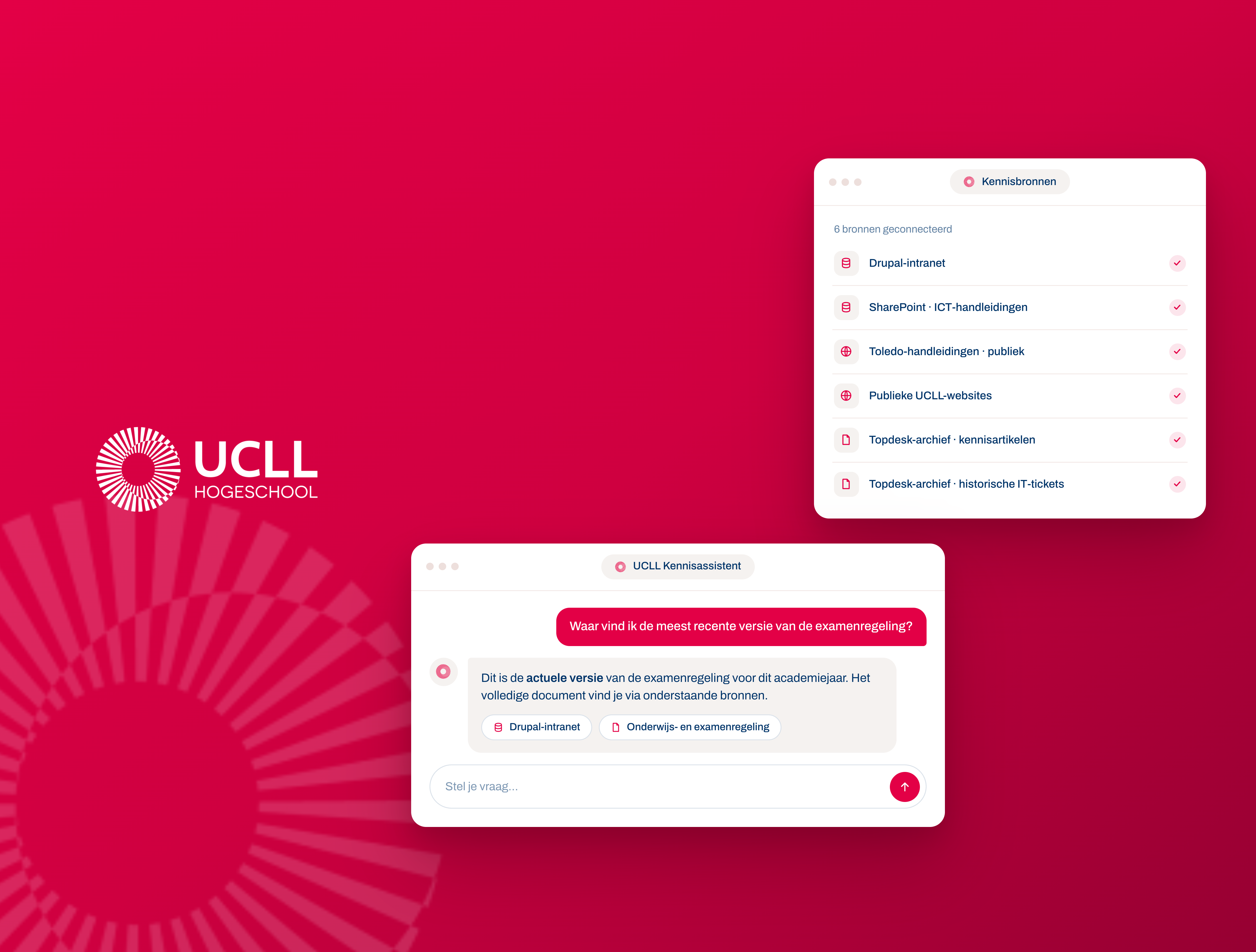
UCLL is one of the largest universities of applied sciences in Flanders, with more than 18,000 students across campuses in Leuven and Limburg. The university rolled out Microsoft 365 Copilot to employees and students, and brought in Arinti to connect Copilot to its institutional knowledge: the Drupal intranet and SharePoint. We design and build the pipeline that turns those sources into intent-aligned Copilot Studio agents, and we coach the IT team to build and govern agents themselves.

Licences are not adoption
UCLL is one of the largest universities of applied sciences in Flanders: more than 18,000 students across campuses in Leuven and Limburg. The university rolled out Microsoft 365 Copilot licences to employees and students alike, and its ambition went further than usage. UCLL wanted teams building their own agents, on their own knowledge.
That ambition ran into a familiar wall. Copilot answers beautifully about anything except the organisation it works for.
Silver medal at Microsoft AI Hackathon
Arinti and UCLL met at the 2025 Microsoft AI Hackathon in Zaventem, where a joint team built a working multi-agent prototype in eight hours and finished second. The prototype proved the idea. Everything above is what it takes to make it real.
The knowledge exists. Finding it is the job.
A lecturer needs the current version of an examination regulation. It might be on the Drupal intranet. It might be on one of the SharePoint sites of the department that owns it. It might be on both, in two versions, and only one of them is current. Three searches later, she mails a colleague, which is how most people at most organisations still find things.
Multiply that by 18,000 students and a few thousand staff, and the cost is not a search problem. It is thousands of small interruptions a week, landing on the people who happen to know where things live.
Connecting Copilot to those sources sounds like a plumbing exercise. It is not. Two things make it hard.
Permissions: A university audience is not one audience. Students, lecturers, and central services each see different things. An agent that answers a student with content from a staff-only HR site is not a useful agent.
Ownership: The intranet team owns the intranet. Departments own their SharePoint sites. Any solution that copies their content into a second place, governed by a second set of rules, creates a shadow system that goes stale the day it ships.
Agents that inherit the permissions you already manage
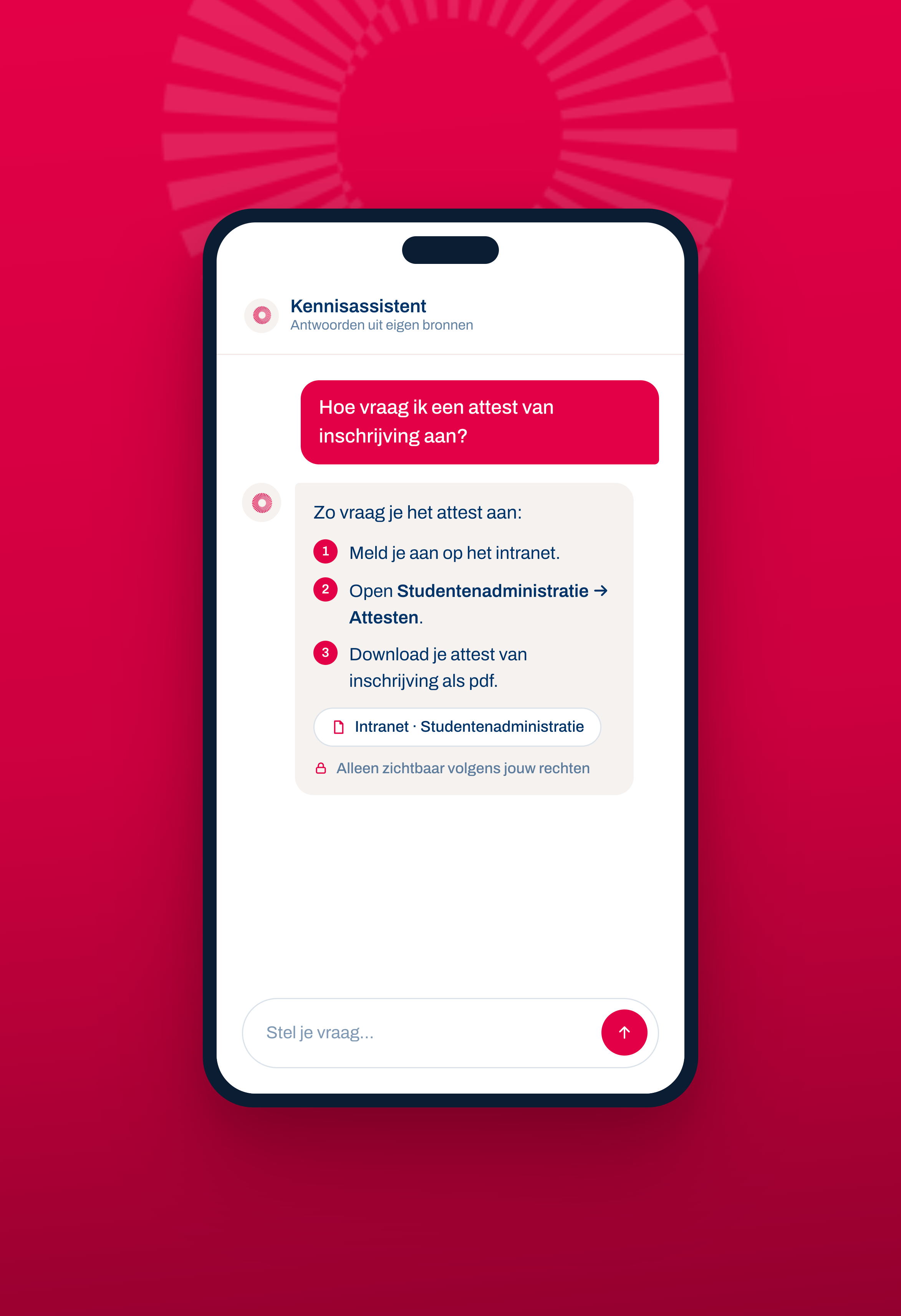
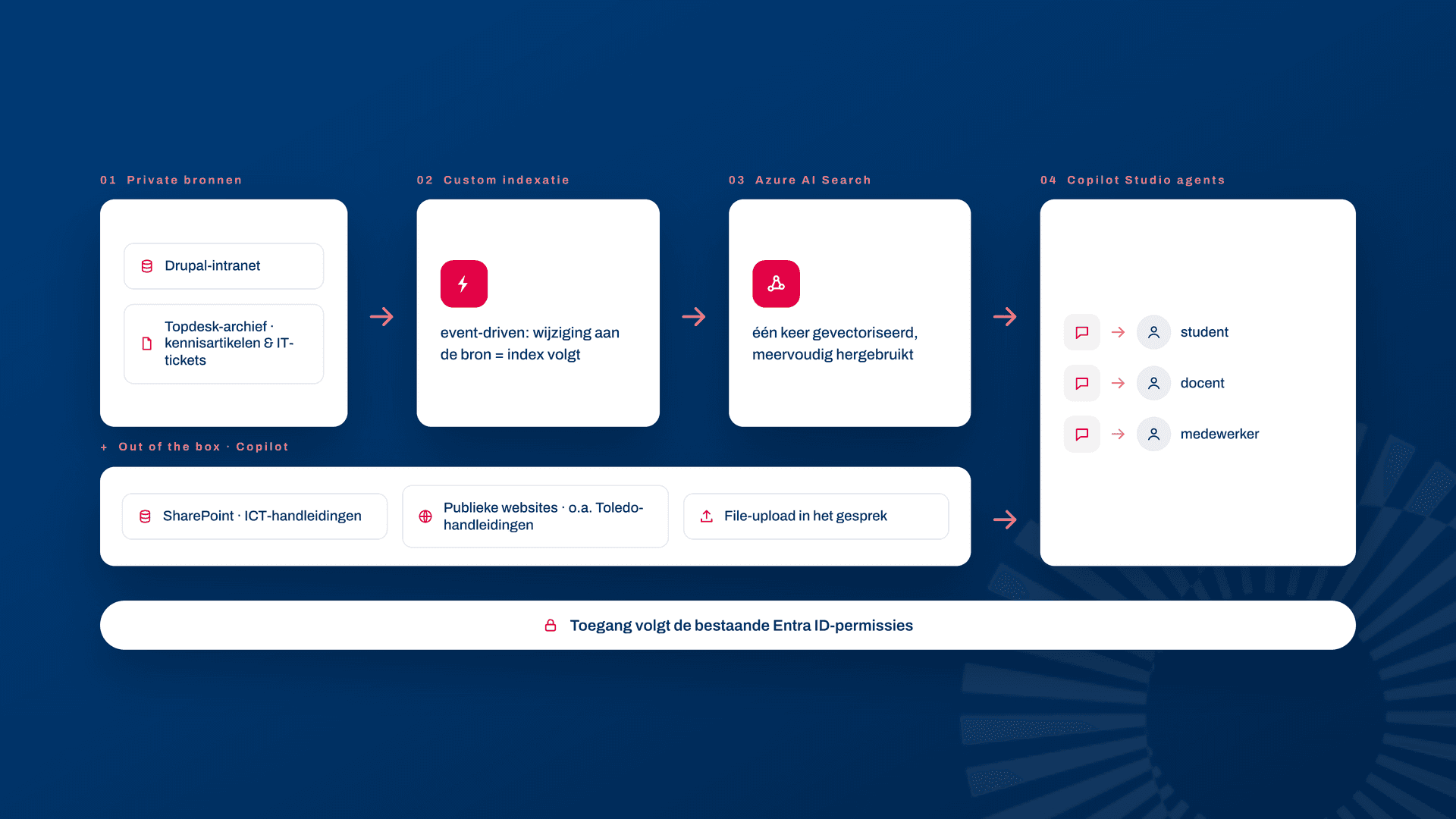
The governance track came first, not last. Access to knowledge follows UCLL's existing Microsoft Entra setup: the identities and groups the university already manages, already maintains, already audits. No parallel permission model, no second place to keep in sync. An agent shows a user what that user could have found themselves.
The same framework covers the agents themselves: who may build one, what it may connect to, and how quality is watched over time. With 150+ Copilot users building or configuring agents, that framework is the difference between a growing agent landscape and an unmanageable one.
Pro-code where it counts, low-code where it scales
UCLL needed two things that usually pull against each other: an architecture shaped to its own landscape, and rollout at the speed of an education organisation.
Custom .NET services carry the work that needs engineering control: extracting, chunking, and vectorising knowledge sources, and exposing them to agents. Copilot Studio and its standard connectors carry the work that should stay light: agent configuration, and SharePoint integration for vetted sites.
That split is the reason UCLL's own team can keep going. The heavy engineering is done once and stays out of the way. The surface where agents get built is low-code, which is exactly where a university's IT team, and eventually its departments, can work without us.
Two principles run underneath. Extraction is event-driven: when content changes at the source, the index follows, without full re-crawls, and the source team keeps ownership. And content is vectorised once and reused: the same vectors serve multiple search capabilities, not a single chatbot.
Designed around intent, not around storage
The agents are built around what staff and students are trying to do, not around where documents happen to sit. That framing is also the groundwork for the next step: agents that do not just answer, but take the next action.
“They didn't just look at what was technically possible, but above all at what would bring our organisation the most value.”
Indexing from Drupal. A .NET proxy API sits between the intranet and Azure AI Search. It picks up content changes, transforms and chunks the pages, and embeds them into a vector index that stays current on its own.
Exposing knowledge to agents. A second proxy API exposes the vector store as a knowledge source and tool inside Copilot Studio. Agents query it in natural language; the same index serves search capabilities beyond the agents.
SharePoint through standard connectors. For vetted sites, out-of-the-box connectors do the job. Custom code is reserved for sources that need it, starting with Drupal.
Infrastructure as code. Azure infrastructure is defined in Bicep, with a deployment pipeline for the proxy APIs and Azure AI Search. Every environment can be rebuilt from code.
Designed to make us less necessary
Alongside the architecture and engineering, we coach UCLL's IT team on Copilot Studio and agent governance: how to design an agent around intent, when a standard connector is enough, how to keep quality measurable.
Copilot Studio was new territory for the team when we started. It is not anymore.
“The collaboration with Arinti on setting up Azure AI Search as the foundation for our Copilot agents is going excellently. Their expertise, pragmatic approach and commitment truly make the difference. They actively contribute ideas, translate technical complexity into workable solutions, and help us build a scalable and future-oriented AI architecture. A particularly pleasant and valuable collaboration!”