 Skip to main content
Sinerisk, independent insurance overview app, from idea to launch in two months
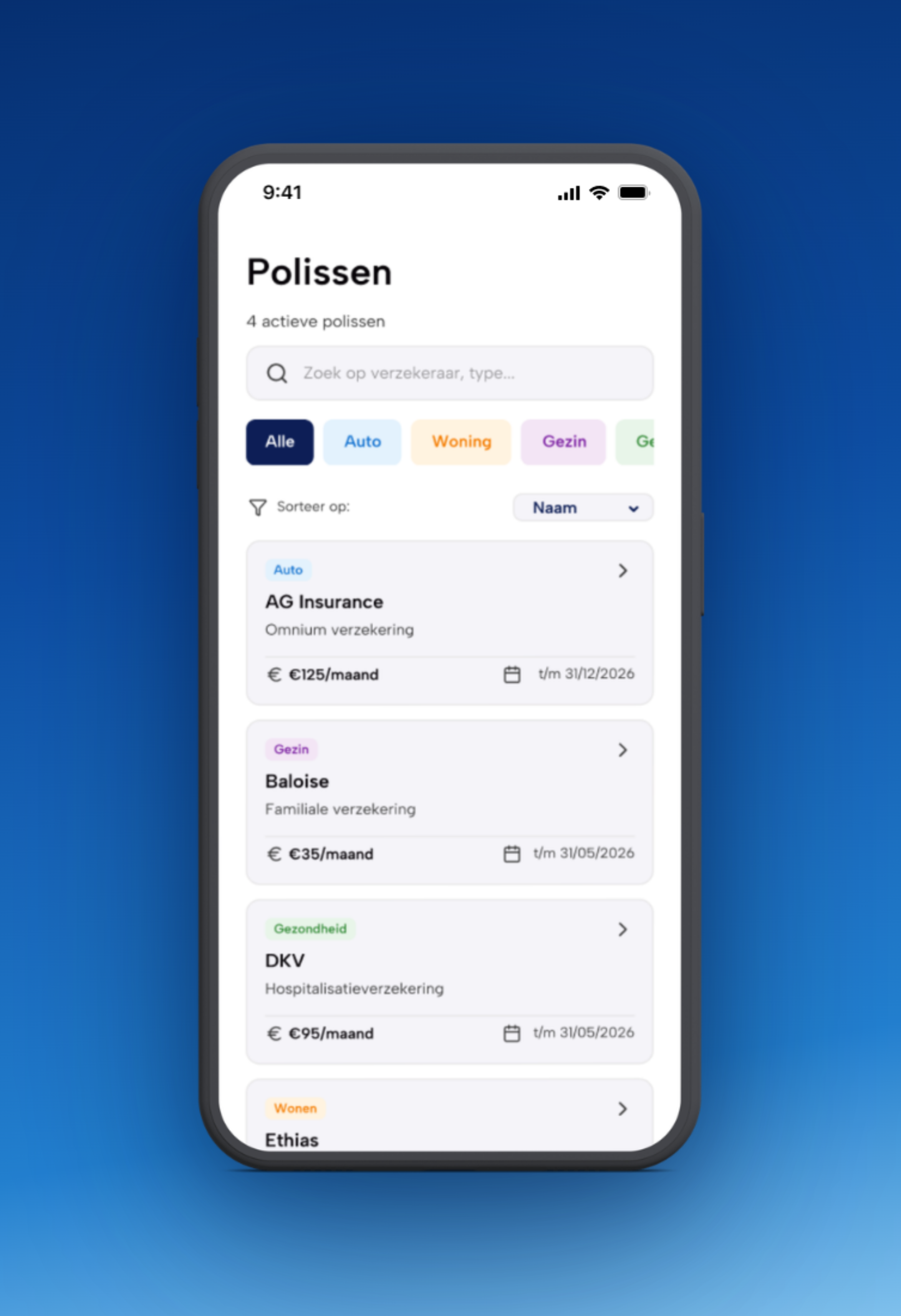
Sinerisk is an insurtech app that gives users a clear overview of all their insurance policies. It bundles a household's policies into one plain-language overview, compares contracts to flag coverage gaps and overlaps, and helps users prepare a claim file when something goes wrong. With Sinerisk, households can see, in plain language, where they're underinsured and where they're paying twice for the same coverage. The app sits as an independent layer between users and their existing insurers, not a broker, not an agent, not selling insurance. Together with founder Mattias Vercauteren, we took the product from idea to launch on the app stores in two months. Fast enough for Sinerisk to start serving real customers, collecting feedback, and iterating from there.
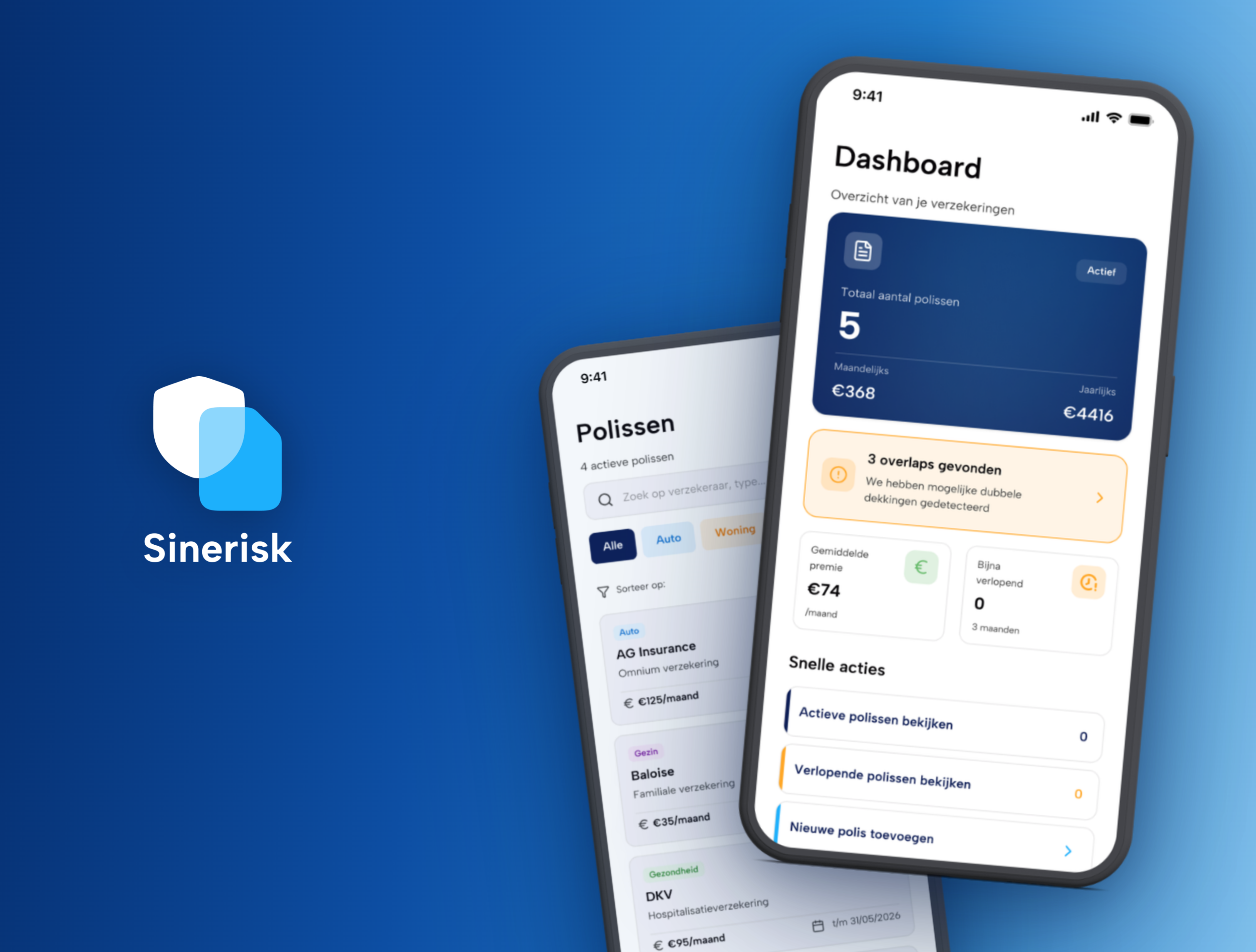

An independent layer on top of insurance
Most Belgian households hold several insurance contracts spread across different insurers and brokers. Policies arrive by email, sit in broker portals, and pile up in paper folders. Each contract uses its own terminology. Coverage gaps and overlaps between contracts are common but invisible to the policyholder. When something does happen, users lose hours collecting documents and remembering what to send to whom.
Sinerisk's founder, Mattias Vercauteren, wanted to fix this with an independent app: a single place where a user uploads their existing policies and sees, in plain language, what they have, what is covered, what is not, and what to do when something goes wrong.
Independence is central to the proposition. Sinerisk is not a broker, not an agent, and does not sell insurance. The product sits as a neutral layer between the user and their existing insurers.
Three core features
A personal insurance overview: every policy, every premium, every renewal date, in a single dashboard on the user's phone. An insurance analysis layer that compares contracts side-by-side and surfaces gaps in coverage, overlapping clauses, and differences in limits and deductibles. And a claim preparation flow that helps users chronologically capture facts, photos, and the right policy details so they can hand their insurer a complete file from the first contact.
Scope tightly, iterate with AI in the loop
Two months is not a lot of time to take a product from idea to production. The first decision was about scope. We sat down with Sinerisk and built a shared list of every feature and service the product could include. Then we decided together on what was really needed to validate the three core flows with real users. Everything else, broker integrations, premium recommendations, referral programmes was moved to a later release.
The second decision was about how to use AI during the build itself. We embedded AI in day-to-day delivery but kept the engineering decisions in the hands of our team. This approach tightened the feedback and development cycle, which is what mattered on a two-month timeline.
A weekly feedback loop
We worked with short iterations of one week. A working app went to the phones of the team at Sinerisk, not a staging URL or slide deck. We used these short iterations to validate functional decisions and to spot product issues early, before they had compounded into rework. The shorter the loop, the cheaper the change.
Flutter and Microsoft Azure
The technology choices were made for one reason: ship a quality consumer app, fast, on a stack that can grow with the product without major rewrites later.
Flutter for one codebase, two stores
The mobile app is built in Flutter. One codebase ships to both the App Store and Google Play, with a single design system and a single test suite. Flutter let the team focus on the user experience instead of on platform parity, and the resulting app performs to native standards on both platforms.
Microsoft Azure
The backend is .NET running on Azure. Authentication, document storage, policy parsing, and the API layer that the Flutter app talks to all live on managed Azure services. The choice was deliberate: a stack the team knows deeply, with mature security tooling, and the scaling headroom the product needs as it moves from early users to a wider rollout.
AI-based policy document parsing
The hardest technical problem in the product is reading a user's existing policies. Belgian insurers each format their policies differently: different PDF templates, different terminology, different structure. We built a document parsing pipeline that extracts the structured data Sinerisk needs (policy type, premium, term, limits, deductibles, broker details) from whatever the user uploads: PDFs, screenshots, photos of paper documents. The pipeline was prototyped in week one and iterated weekly against real policies, so the accuracy on launch day reflected real-world variety rather than a clean lab dataset.
Security and scalability
Insurance data is sensitive personal information. Security was not treated as a follow-up phase. From the first sprint, the backend used managed identities, encrypted storage, scoped access policies, and audit logging. The same applied to scalability. The API and document parsing layer were designed to scale horizontally on Azure from day one, not retrofitted when usage picked up.
Metabase reporting
From the first release, every flow in the app emits structured events, and every event lands in a Metabase instance that Sinerisk uses daily for monitoring and analytics.
The dashboards cover both sides of the product. On the user side: how many policies are being uploaded, which document types parse cleanly and which do not, where users drop off in the claim preparation flow, which insights they read and act on. On the business side: signup conversion, retention by cohort, early-user feedback signals, and the metrics tied to Sinerisk's strategic goals. Sinerisk has end-to-end visibility into product usage and business performance.
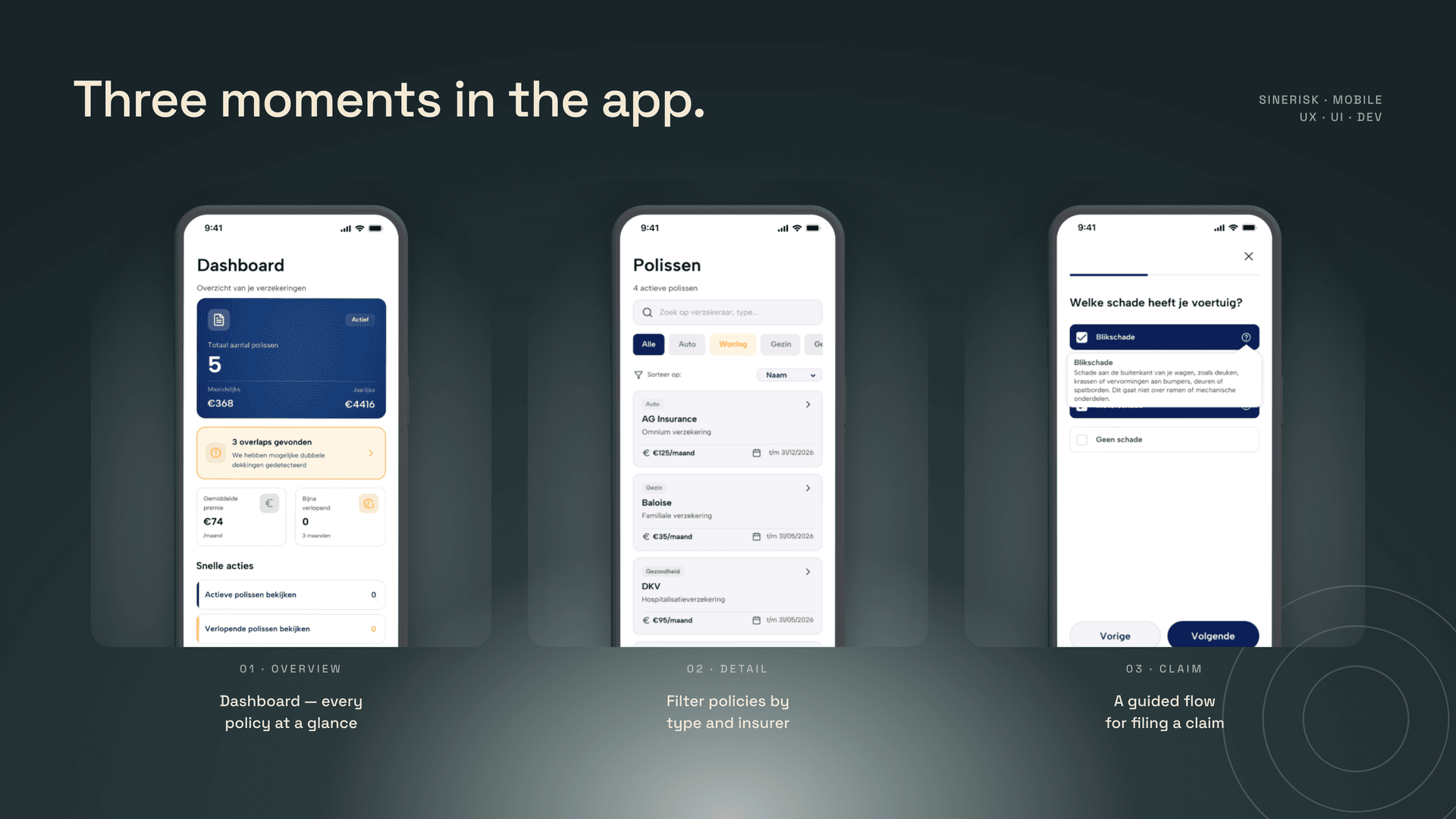
“We had two months to go from a slide deck to a real app in users' hands. Arinti kept the scope honest, what was needed to validate the product, and nothing more. Only two months later we had launched the app on the app stores.”
What two months made possible
Two months from the first scoping session, Sinerisk was live on both the App Store and Google Play, with the core features working end to end. For Sinerisk, that timeline is the result: every week not in market is a week not learning and gathering feedback. AI in the delivery loop is what made this timeline possible. AI did not replace engineering decisions; it tightened the cycle between them.